


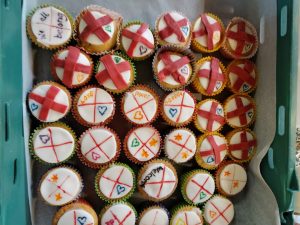
One of my all time favourite bits of comedy is Eddie (now Suzy) Izzard’s legendary ‘cake or death’ sketch. If you don’t know it, the joke centres on gently teasing the Church of England for its tea-and-cake-with-the-vicar moderation.
The C of E doesn’t really do extremism, Izzard observes, wondering what it might have looked like if the C of E had been in charge of the Spanish Inquisition. (“Talk, will you, talk!” “But it hurts!” “Well… loosen it up a bit, will you?”)
This then leads in to a truly bonkers few minutes where Izzard imagines a succession of people being given a choice between tea-and-cake, or death.
It’s not entirely clear who’s forcing them to make this choice.
What is clear is that people prefer the cake option.
Maybe it’s easiest if you just watch it. (Here’s the stop-motion Lego version, because hurrah for the internet.)
This sketch gets quoted a lot on Friday nights in Seacroft on the edge of Leeds, where two Church of England vicars and a growing cast of volunteers have started responding to weekly protests (and counter-protests) outside a hotel housing asylum seekers with the quietly radical act of… offering cake.
But I’m getting ahead of myself. Let’s go back a step.
This is the church of St James’s in Seacroft. It was in the middle of the countryside when it was built, halfway through the 19th century.
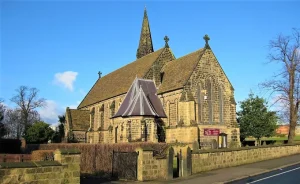
These days, it’s in the middle of a different kind of estate: one of the biggest housing estates in Europe, made up of 1960s houses and massive tower blocks.
Anne Russell, the vicar for the parish of Seacroft, observes that it has “the classic problems of a poor estate” – not just cost-of-living poverty, but also “the poverty of being isolated and looked down on”. 39% of kids there live in poverty that Anne calls “grinding”.

Yet despite its challenges, Anne stresses that there’s a lot more to Seacroft than deprivation. People have worked hard to build connection among its diverse residents. The schools are great, and ambitious for their kids. People are proud to live here.
Right in the middle of Seacroft, across a roundabout from the area’s shopping centre, is the Britannia Hotel, which is at present home to a group of male Christian and Muslim refugees. And that’s where our story begins.
The first protestors weren’t local, Anne says; instead, it was “agitators from outside”. They tried to start protests last year and the year before, but they “just didn’t stick”.
But this year, they did stick, and now, it’s a weekly event. And if you go along on a Friday evening at 6pm, you’ll find several groups of people.
On one side of the road are the anti-migrant protestors, many of them shouting Islamophobic abuse towards the hotel.

On the other side of the road, just outside the hotel, are a group of counter-protestors organised by Stand Up To Racism, which organised itself almost as soon as the anti-migrant protestors got going.

The result, Anne observes, is a “ping pong effect” of the two sides shouting at each other. Typically, you find a couple of hundred people on either side of the road, liberally equipped with flags, megaphones, and chants, with each side trying its hardest to drown the other side out.
In between them, finally (along with a lot of police), you’ll find a third group of people, holding trays of cake.
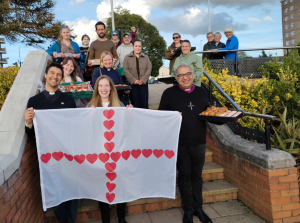
Heston Groenewald (that’s him at bottom left) is the vicar of All Hallows, in the Hyde Park area of Leeds. It’s on the other side of Leeds from Seacroft, but he and others from All Hallows started coming over each week partly to be allies to Anne, and partly because All Hallows is heavily involved in supporting refugees and they wanted to show up to support them too.
One week, while Anne was speaking to the counter-protestors, Heston and his friend Adam – a Muslim – decided to walk across the road and start chatting to people on The Other Side. It was a small seed from which a lot has grown.
Over time, more and more people have joined in. Now, there’s a much larger group of people having conversations – not just from Anne’s and Heston’s parishes, but also from local Quaker groups and what Heston calls “non-churchy kindred spirits”.

So how do you start a conversations with someone shouting abuse, I ask?
It all starts with “would you like some cake?”, Heston replies.
It doesn’t have to be cake – this week, the bridge builders are bringing along knitted goodies that have been made by the Leeds Craftivist community – but there’s always an offer of something. It’s a way to defuse hostility and suspicion, and to set a tone of hospitality and friendliness.
I ask Heston about what he hears from the anti-migrant protesters as he and his fellow cake-bringers stand there listening to them.
To be sure, he observes, there’s an extreme minority who have “vile, horrible” racist views. “Each time I’ve managed to talk to them, they’ve come from outside Leeds,” he adds.
But “the majority of the folks there, aren’t really there to be racist”, he stresses. They do want to vent. They’re people who feel that “we just haven’t been listened to by successive governments for a long, long time”. People tell him that “we don’t sign up to everything these guys stand for, but they listen to us – and so here we are”.
They listen to us, and so here we are.
I feel like there’s something really important in those nine words – something that Anne and Heston have clocked and are doing something pratical and positive about, and that has the potential to go much wider. (As I was writing this, I discovered that something very similar is happening in the Hodge Hill area of Birmingham, thanks to Al Barrett, another Church of England vicar.)
So what’s the purpose of doing this work? As I chatted to Anne and Heston, it felt like three strong reasons emerged.
First, to dial down the temperature. Extremists like the outsiders who’ve come to Seacroft to try and stir up trouble are always looking for ways to raise the temperature, to take people into a fight-flight-freeze state. And as last summer’s riots (including in Leeds) show, sometimes they’re able to succeed in making things boil over. When they do, really bad stuff happens.
But it’s much harder for people to feel furious when someone’s engaging them in friendly conversation and really listening to what they’re saying (or when a vicar is offering you tea and cake). It’s simple. But effective.
Second, to resist dehumanisation. The far right thrives when people perceive themselves to be one side of a them-and-us divide, and start to see the other side as inherently inferior or threatening. (Often, of course, what happens is that both sides come to see the other in this way.)
This is exactly what the cake-bringers are seeking to disrupt. I think it’s significant that they’re not just talking to the anti-migrant protestors. Instead they’re talking to everyone – protestors, counter-protestors, police, asylum seekers. And in doing so, they’re defying the ‘othering’ that the extremists seek by making the point through their actions that everyone has inherent value.
And third, to engage in a battle for hearts and minds. The cake-bringers get that they’re never going to win over the small minority of hardcore racists. But they also know that most of the protestors, especially those who are actually from Seacroft, are not racists, and are instead motivated more by intense frustration that no one’s been listening to them.
The far right get that, and so they listen as a way of seeking to win people over.
And this, too, is part of the dynamic that the cake-bringers are (brilliantly) disrupting and remixing.
Instead of shouting at the protestors, which would simply create yet more of the them-and-us dynamic that the far right thrives on, they’re listening to them — because why should the far right have a monopoly on the power of listening?
It’s all quite subversive, in a very English, tea-and-cake sort of way. And there are signs that it might be working.
Numbers at the protests have been slowly dwindling. People in Seacroft are sensible and have better things to do on a Friday night, notes Anne — although, she adds with a chuckle, she also prays each week for heavy rain or for something unmissable to be on the telly.