


We’ve spent the past year training people in Yorkshire and South Wales to have conversations about climate change.
This is the first time we’ve delivered Let’s Talk Climate on a regional basis and we’ve learned a lot – about the sector as a whole, the benefits of this kind of approach, and why we’re more convinced than ever that more organisations should be investing in conversations-based campaigns.
Our brilliant trainees have yet again proven that climate conversations can happen anywhere and with anyone, but if conversations are to reach their true potential at scale, we (sector leaders and funders) need to resource and support them properly.
Here’s what we’ve learned:
1. Regional approaches for the win!
Delivering training on a regional basis has helped to catalyse and deepen local campaigning ecosystems.
We connected local climate action groups and they’ve been busy collaborating and learning from each other. This has worked particularly well in Yorkshire, where local groups teamed up to deliver and promote the training, creating a broader community and opportunities to share ideas and expertise.
For example, some of them have gone on to host screenings of the National Emergency Briefing – a climate information film that is being shared at events run by grassroots groups – and facilitated climate conversations afterwards.
This type of ‘follow-on’ activity, where trainees can put their new skills to good use straight away, helps to embed their knowledge and deepen their bonds with other trainees – and is something we know they value highly. Above all, generating these kinds of local campaigning ecosystems can help local groups to achieve impact not just in their neighbourhoods, villages, or towns, but at regional or even national level too – and that’s going to be vital for the future.
If you’re thinking about delivering conversation training, you should think about how you’ll continue to nurture these connections once it’s over. What opportunities can you offer to your supporters to practice their new-found skills? How will these people meet and act together in the future?
2. Free training isn’t always enough
Recruiting our delivery partners took a lot longer than in previous years. In some cases it took us months to get organisations on board and this was particularly true in South Wales.
Considering this is training that we are able to offer organisations and their supporters for free, it’s very clear that free is not always enough: many potential partners were already so overloaded that they just couldn’t dedicate the time or resources to support it.
Even those with paid employees struggled. One partner’s sole employee had recently had his hours cut by eighty per cent due to lack of funding. In those circumstances, opportunities like free training become yet another thing to add to an already unsustainable to-do list.
When trying to engage local climate action groups, the elephants in the room were money and class. The groups that were most successful in recruiting participants were those in Yorkshire led by mostly retired people living in rural villages who have lots of social capital and time to dedicate to causes they believe in.
That’s not to undermine what those groups were able to achieve – because the results they had were fantastic – but to highlight that not everyone who wants to bring this training to their supporters is starting from the same place.
In South Wales, we had chats with many campaigners who loved the idea of bringing the training to their groups but just couldn’t commit the time to supporting it.
There’s no magic bullet that will fix this: it’s a sector wide issue, and one which we know other sectors, like those working on migration, are experiencing as well. But it’s absolutely central to everyone we work with, and something to keep in mind constantly.
3. Supporters are overstretched too
It’s not just organisations and their employees who are feeling the pinch – their supporters are too. This was the first year in which some partners struggled to recruit the number of trainees we saw in previous cohorts.
In our debriefs with partners they told us how difficult it is for people, particularly those of working age, to fit new opportunities into their lives, especially longer term commitments like the 6-week Challenge element of the training.
As the cost-of-living crisis continues to impinge on people’s lives, they are working longer hours to keep their heads above water. People with caring responsibilities are finding the juggle harder than ever before. While these pressures aren’t a new phenomenon, our hypothesis is that the impact of them has accumulated over time – with the effect that people just have less energy and time even for causes we know they care about.
It is clear to us that when people are able to commit to the training Workshop and/or Challenge they find both extremely valuable but it seems getting ‘bums on seats’ is trickier now than when we started four years ago.
We have to ask ourselves, how well are we caring for our volunteers and supporters? Are we asking too much? And which priorities really matter?
Why make conversations part of your campaign strategy?
So why are we more convinced than ever about the value of conversations as a campaign tool – even when both the sector and the people it serves are feeling overstretched?
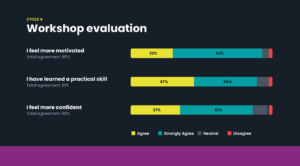
Well, we now have two important pieces of information. First, we know that conversation training has a huge impact on an individual’s ability to start and hold a skilful climate conversation – our evaluation results and trainee conversation records attest strongly to this.
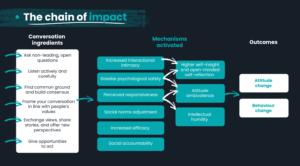
Second, as outlined in our recent report, the academic evidence is clear that conversations, held skilfully, can shift people’s attitudes and behaviours because they activate the psychological mechanisms necessary for us to change our mind about something.
For example, active listening creates greater psychological safety which leads to higher self-insight which leads to attitude change.
In short, conversations work! So how do we translate this knowledge into campaign wins? Organisations can start by:
– Embedding conversations into the way they do campaigning. Make it a core skill that supporters are equipped with in the same way you train people to run an event or do a bat survey or conduct a health and safety assessment.
– Giving conversations equal weight in campaign strategies. Just as no campaign is complete without a social media plan, neither should it go ahead without a conversation plan. Who are your most effective conversationalists? How can they be deployed? What audiences can they reach that other tactics can’t?
– Learning from conversations. Often the most successful conversations are the ones in which you find out information, rather than impart it. This year, trainees recorded their standout conversation each week in their group’s ‘Challenge tracker’ spreadsheet and from this data we were able to pinpoint trends. For example, some of the most fruitful conversations people had were with ‘everyday experts’ – the people who notice climate impacts as part of their work, like window cleaners. We were then able to aggregate these stories to help encourage others to strike up similar conversations.
What ways could your organisation use conversation insights? Might they help with campaign research, planning and evaluation? Or content creation? You may find that reflecting on conversation records might help to challenge your assumptions about what your target audience knows, thinks and feels about a particular issue.
If you’d like support to make this happen, we have some invitations for you:
– Book a call with us to talk through how conversations can support your upcoming campaigns – we can share our learning and point you in the direction of research, case studies and other orgs who might be able to help you.
– Advocate for the power of conversations within your organisation by sharing our latest report, or some of the case studies on this website with your leadership team.
– Join the Curious Conversations Impact Group if conversations are already part of your campaigns, no matter what stage. Learn from other orgs and help shape our future research. The CCIG is now 45 members strong including large charities like Greenpeace, place-based community organisations like Bridges for Communities in Bristol, and experts like the Climate Research Group at the University of Manchester.
Thank you
Thank you to our brilliant partners: Climate Action Ilkley, Climate Action Leeds, Greenpeace, Green Voices, Gwent Wildlife Trust, North Yorkshire Climate Coalition, Yorkshire Wildlife Trust, and Zero Carbon Harrogate. You inspire and challenge us in equal measure!
Big thanks also to the European Climate Foundation for supporting this work and to Climate Cymru who introduced us to potential partners in South Wales.